

If you scroll through Reddit, TikTok, or group chats often enough, you have probably seen the letters AITA pop up somewhere. The AITA meaning behind this short abbreviation has grown far beyond its original home, and it now shapes how millions of people talk about conflict, morality, and everyday decisions online.
This guide covers the full meaning of AITA, its history, every possible verdict, real examples, etiquette rules, and much more. By the end, you will understand not just what AITA stands for, but why it became one of the most recognizable internet acronyms of the last decade.
What Does AITA Mean?
The AITA meaning is simple at its core, but the way people use it has become surprisingly layered.
AITA stands for “Am I The Asshole.” It is a question someone asks when they want an outside opinion about whether they behaved badly in a specific situation.
The phrase started as the name of a Reddit community, but the AITA meaning has since expanded into everyday slang used across nearly every social platform.
Core Definition:
At its most basic level, the AITA meaning refers to a self assessment question. Someone describes a conflict or decision they were part of, then asks strangers or friends to judge whether they were in the wrong.
It also helps to separate the literal AITA meaning from the way it feels in practice. Literally, it is a question about fault. In practice, the AITA meaning has become shorthand for an entire style of storytelling, one that invites strangers to weigh in on personal choices that would normally stay private.
That gap between the literal AITA meaning and its everyday use is exactly why so many people search for a full explanation. A quick definition covers the words, but understanding the culture around it takes a bit more context.
Must Read This : ALR Meaning in Text: 7 Proven Ways to Use It in Chats
Origin and History of AITA
The AITA meaning traces back to a subreddit called “Am I The Asshole,” which launched in 2013. The community was built around a simple premise: users post a personal conflict, and other members vote on who was at fault.
Early growth was slow and steady. The subreddit built a loyal base of readers who enjoyed the mix of drama, moral debate, and community judgment.
Around 2018 and 2019, the subreddit exploded in popularity. Viral posts started getting shared outside Reddit, and news outlets began covering some of the wildest AITA stories.
By the early 2020s, the AITA meaning had escaped Reddit entirely. People began using the phrase in text messages, on Twitter, and in everyday conversation, even when no formal post was involved.
Today, the AITA meaning is recognized well beyond its subreddit roots. It functions almost like a mini genre of storytelling, one built entirely around moral judgment and public opinion.
Part of the reason the community grew so large is that it filled a gap other forums did not. Advice communities existed long before AITA, but most of them focused on solving a problem rather than assigning blame. The AITA meaning offered something different: a clear, structured judgment that readers could scan in seconds.
The subreddit also benefited from strong moderation early on. Rules around posting format, honesty, and civility kept the community from collapsing into pure chaos, which helped it maintain a loyal readership even as it scaled into the millions.
By the time major podcasts and YouTube channels started reading AITA stories aloud, the format had already proven itself as reliable, repeatable content. That reliability is a big part of why the AITA meaning has stayed relevant for so many years instead of fading like many other internet trends.
Looking back at the growth curve, the AITA meaning followed a pattern common to many internet phenomena. It started small, gained traction through word of mouth, then exploded once mainstream media and video creators discovered it. What makes the AITA meaning different from many of those other trends is that it never really faded afterward. Instead of disappearing once the initial hype cooled, the format settled into daily use across dozens of platforms, which is why new readers are still discovering the AITA meaning for the first time every day.
The Complete AITA Verdict System
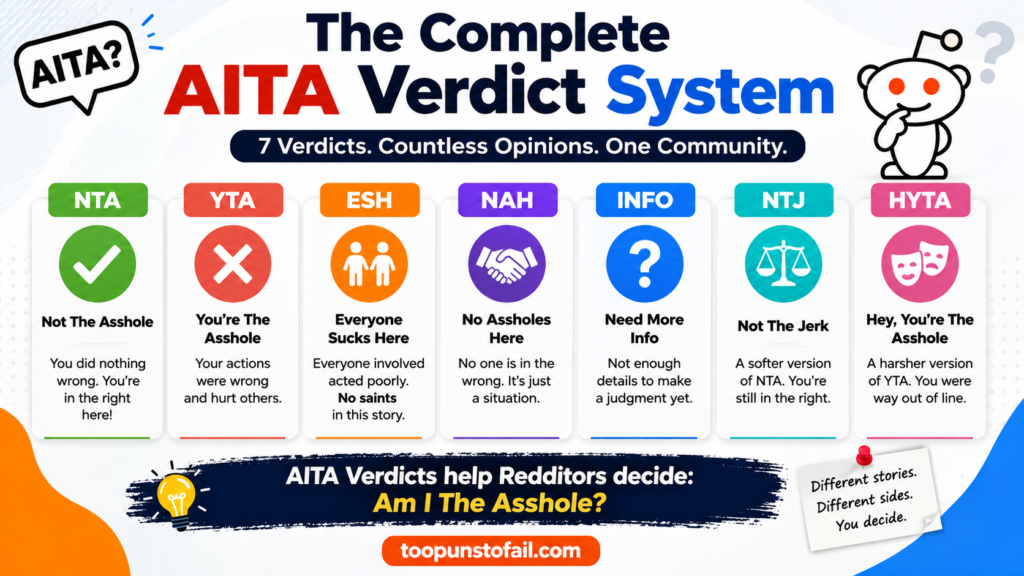
Part of what makes the AITA meaning so easy to understand is its verdict system. Every response falls into one of a small number of categories, which keeps judgments consistent and easy to scan.
These verdicts are the backbone of the entire format. Without them, AITA would just be storytelling with no clear conclusion.
The five main verdicts are:
- NTA: Not The Asshole
- YTA: You’re The Asshole
- ESH: Everyone Sucks Here
- NAH: No Assholes Here
- INFO: Not Enough Information
Each one carries a distinct meaning, and choosing the right verdict is part of the fun for regular readers.
This verdict system is also what separates the AITA meaning from a plain advice column. Instead of a long written response, readers boil their opinion down to a short label, which makes the AITA meaning easy to apply consistently across thousands of different posts and situations.
When Each Verdict Gets Used
Knowing the AITA meaning is only half the picture. Understanding when each verdict applies is what makes the system useful.
NTA gets used when the poster acted reasonably and the other party was clearly in the wrong.
YTA applies when the poster is the one who behaved badly, even if their intentions were good.
ESH shows up when both sides handled the situation poorly, even if one side was worse than the other.
NAH is reserved for situations where nobody did anything wrong, but there was still a conflict or disagreement.
INFO gets used when commenters feel the story is missing key details needed to form a fair judgment.
Picking the correct verdict takes some practice, but most active readers pick it up quickly.
Real AITA Examples Across Different Situations
The AITA meaning becomes clearer once you see it applied to real scenarios. Below are several examples covering different areas of life, each showing how the format plays out in practice.
Example 1: Family Conflict
Someone skips a sibling’s wedding because it falls on the same day as a long planned trip. They ask if they are the asshole for prioritizing themselves over a major family event.
This is a classic AITA meaning setup because it involves competing obligations and no obvious right answer.
Example 2: Friend Group Drama
A person cancels plans last minute after finding out a friend invited someone they dislike. They wonder whether canceling was fair or whether it damaged the friendship unnecessarily.
Friend group stories are some of the most common posts, since social dynamics rarely have a clean resolution.
Example 3: Workplace Situation
An employee refuses to cover a coworker’s shift for the third time in a month. They ask whether they are the asshole for finally saying no after being flexible before.
Workplace posts often split opinion, since fairness and boundaries can be viewed differently depending on the reader.
Example 4: Everyday Decision
Someone eats the last slice of pizza without asking a roommate first, even though the roommate had mentioned wanting it earlier. They ask if this small decision makes them selfish.
Everyday decision posts show how the AITA meaning applies even to minor, low stakes situations.
Example 5: Relationship Conflict
A partner sets a firm boundary about not discussing finances with extended family, and the other partner breaks that boundary during a holiday gathering. They ask for judgment on how the situation was handled afterward.
Relationship posts tend to generate long comment threads because readers often relate personally to the topic.
Example 6: Casual Joking Use
A friend jokingly texts “AITA for eating your leftovers” after finishing food from the shared fridge. There is no real conflict here, just a lighthearted use of the phrase.
This example shows how far the AITA meaning has drifted from its original serious context into pure humor.
Example 7: Text Conversation
Two friends argue over text about who was late to a plan, and one of them types “lol AITA” as a way to defuse the tension. The phrase becomes a shorthand for acknowledging fault without a full apology.
Text conversation use is now one of the most common ways the phrase appears outside Reddit itself.
AITA Abbreviations and Common Terms Explained ⭐
Beyond the core AITA meaning, there is a whole vocabulary that goes along with it. Knowing these terms makes it much easier to follow discussions and comment sections.
NTA, YTA, ESH, NAH, and INFO
These five verdicts form the foundation of every AITA discussion.
NTA and YTA are the two most common responses, since most conflicts have a clearer side that is more at fault.
ESH and NAH are less common but show up in more nuanced situations where blame is shared or absent entirely.
INFO is used sparingly, mostly when a post leaves out details that would change the verdict significantly.
Learning these abbreviations is essential for anyone trying to fully grasp the AITA meaning in context.
How AITA Is Used Beyond Reddit
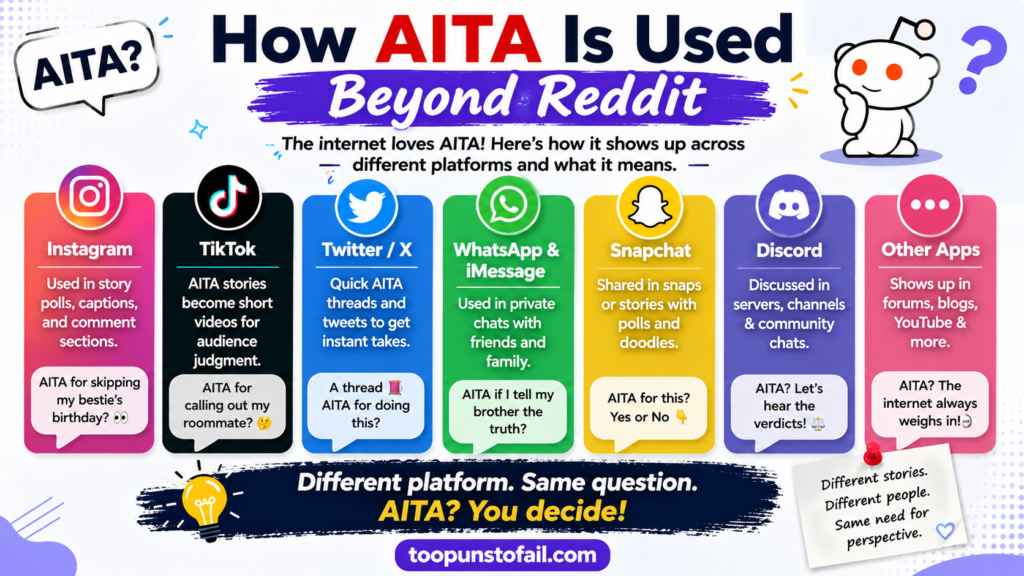
The AITA meaning has expanded well past its original subreddit. It now shows up across nearly every major platform, often in ways that have nothing to do with formal posts.
This spread happened gradually, as users who grew up on Reddit carried the AITA meaning with them into other apps. Once it became common slang rather than a platform specific term, the AITA meaning stopped requiring any explanation at all for most younger internet users.
On Instagram, people use AITA in captions or story polls to get quick reactions from followers about a decision they made.
TikTok
TikTok has entire video formats built around reading AITA stories aloud, often with dramatic reactions or commentary layered on top.
Twitter and X
On Twitter and X, the phrase gets used both seriously and jokingly, often attached to short personal anecdotes or hot takes.
WhatsApp and iMessage
In private messaging apps, AITA often appears as a casual question between friends, used to settle small disagreements quickly.
Snapchat
On Snapchat, the phrase shows up in captions or chat messages, usually tied to quick personal stories shared with close friends.
Discord
Inside Discord servers, AITA threads are common in community channels, where members post situations and let other users weigh in.
How to Respond When Someone Asks “AITA?” ⭐
Once you understand the AITA meaning, the next step is knowing how to respond when someone actually asks you the question directly.
Honest Responses
An honest response addresses the situation directly, even if the answer is not what the person wants to hear. This keeps trust intact and avoids empty validation.
Supportive Responses
A supportive response acknowledges the person’s feelings first, then offers a gentle opinion. This works well for sensitive situations involving family or relationships.
Funny Responses
A funny response leans into the lighthearted side of the format, often exaggerating the verdict for comedic effect rather than offering real judgment.
The Psychology Behind Why People Love AITA
There is a real psychological pull behind the AITA meaning that explains why the format spread so widely.
1. The Need for Validation
Many posters are not really looking for criticism. They want confirmation that their choice was reasonable.
2. The Appeal of Judgment
Readers enjoy playing judge for a moment, forming an opinion quickly based on limited information.
3. Moral Clarity in a Complex World
Real life rarely offers clean answers. AITA posts package messy situations into a simple verdict, which feels satisfying.
4. Connection Through Shared Experience
Many readers relate personally to the situations described, which creates a sense of shared experience even among strangers.
5. Safe Space for Moral Learning
The format lets people reflect on their own past choices by comparing them to someone else’s story, without any real world consequences.
Together, these five factors explain why the AITA meaning resonates so widely. It taps into curiosity, empathy, and a basic human desire to understand right from wrong, all packaged into a format that takes only a few minutes to read.
Researchers who study online communities have pointed to similar patterns in other judgment based platforms, noting that people are drawn to low stakes moral decisions because they allow for strong opinions without any personal risk. The AITA meaning fits neatly into that broader psychological pattern, which helps explain why it has remained popular for so long instead of fading like many short lived internet trends.
Why AITA Went Viral So Quickly
The AITA meaning caught on quickly because it combined storytelling, drama, and quick judgment into one easy to consume format.
Short posts were easy to read on mobile devices, which helped the community grow rapidly during a period when mobile Reddit usage was rising sharply.
News outlets picked up especially dramatic stories, which introduced the format to audiences who had never used Reddit before.
Once TikTok creators began narrating AITA posts, the format reached an entirely new generation of users who associate it more with video content than with the original subreddit.
AITA Etiquette: How to Use It Respectfully ⭐
Using the AITA meaning correctly involves more than just knowing the verdicts. There is an unwritten etiquette that regular users tend to follow.
Be honest about your own role in the situation, even details that make you look bad.
Avoid leaving out information just to sway the verdict in your favor.
Respect the final judgment, even if it is not the one you hoped for.
Keep personal information limited, especially when posting about real people who might see the story.
Following these guidelines keeps the format fair and useful for everyone involved.
It also helps to remember that real people are often on the other side of these stories, even if they never see the post themselves. Treating the situation with the same care you would want if someone were writing about you tends to lead to more thoughtful posts and more useful responses.
Experienced members of the community also recommend waiting before posting when emotions are still running high. A post written a day or two after a conflict, rather than in the middle of it, usually reads as more balanced and is more likely to receive a fair judgment from readers.
How to Write a Good AITA Post
A strong post follows a clear structure, which makes it easier for readers to form an accurate judgment.
Start with context, explaining who is involved and what the relationship is.
Describe the conflict clearly, including what each person said or did.
Explain your own reasoning, so readers understand why you made the choice you did.
End with the direct question, asking clearly whether you were in the wrong.
Posts that follow this structure tend to get clearer, more useful responses.
Common Mistakes People Make With AITA ⭐
Even experienced posters make mistakes that weaken their story or confuse the judgment process.
Leaving out important details is one of the most common issues, since it often changes the verdict entirely.
Writing overly one sided accounts can make readers suspicious, especially if the other party is described unfairly.
Posting purely to get validation, rather than an honest opinion, tends to backfire once readers notice the pattern.
Using the format for extremely serious topics, like abuse or safety concerns, is generally discouraged, since it is not designed for situations that need real support.
What NOT to Do When Using AITA
Beyond common mistakes, there are a few things people should actively avoid.
Do not use it to publicly shame someone without their knowledge, especially with identifying details included.
Do not treat the verdicts as absolute truth, since readers only see one side of the story.
Do not rely on it as a substitute for professional advice in situations involving legal, medical, or safety concerns.
Do not take the judgment personally to an extreme degree, since it is meant to be a casual opinion, not a formal ruling.
AITA in Meme Culture
Beyond serious posts, the AITA meaning has become a major part of meme culture. Screenshots of dramatic posts get shared for entertainment, often stripped of their original context entirely.
Meme pages regularly repost the most outrageous stories, turning ordinary conflicts into widely recognized internet jokes.
The phrase itself has become a punchline, used ironically in situations that clearly do not need any real judgment at all.
AITA Variations You Should Know
Several spinoff formats have grown out of the original AITA meaning, each with a slightly different focus.
AITAH is a similar community with looser posting rules and fewer restrictions than the original subreddit.
WIBTA, meaning “Would I Be The Asshole,” is used when someone is asking about a decision they have not made yet.
TIFU, meaning “Today I F’ d Up,” focuses more on personal mistakes than moral judgment.
These variations share the same basic spirit as AITA but shift the focus slightly depending on the situation being described.
AITA vs Similar Internet Formats
Comparing the AITA meaning to other internet formats helps highlight what makes it unique.
Unlike advice focused communities, AITA is centered entirely around judgment rather than solutions.
Unlike confession style formats like TIFU, AITA specifically asks for a verdict rather than just sharing a story.
Unlike relationship advice forums, AITA tends to be shorter, faster paced, and more focused on quick reactions than deep discussion.
This combination of speed, structure, and judgment is what sets the format apart from similar online spaces.
AITA Meaning Across Different Generations
The AITA meaning does not land the same way with every age group, and it is worth looking at how usage shifts across generations.
Younger users, especially teens and young adults, tend to treat the AITA meaning as casual slang. For this group, it often shows up in jokes or quick text exchanges rather than full length posts.
Older users, particularly those who joined Reddit in its earlier years, are more likely to associate the AITA meaning with the original subreddit format, including longer posts and detailed comment threads.
This generational split is part of why the AITA meaning can feel different depending on where you encounter it. A TikTok viewer might know the phrase purely as entertainment, while a longtime Reddit user sees it as a structured system for resolving disputes.
Despite these differences, the core AITA meaning stays consistent everywhere it appears. Whether it is used seriously or as a throwaway joke, the underlying question is always the same: was this person in the wrong.
Quick Reference Summary
Here is a short recap of the AITA meaning and the key points covered in this guide.
AITA stands for “Am I The Asshole” and began as a Reddit community built around personal conflict stories.
The verdict system includes NTA, YTA, ESH, NAH, and INFO, each representing a different outcome.
The format has spread across Instagram, TikTok, Twitter and X, WhatsApp, Snapchat, and Discord.
Good etiquette involves honesty, fairness, and respecting the final verdict, even when it is unwanted.
FAQs About AITA Meaning
The questions below cover the most common searches related to the AITA meaning, from casual texting use to community etiquette.
What does AITA mean in texting?
In texting, AITA usually means the same thing as its original definition: “Am I The Asshole.” It is used casually to ask a friend for a quick opinion on a small conflict or decision.
Is AITA only used on Reddit?
No. While the AITA meaning started on Reddit, the phrase is now common across Instagram, TikTok, Twitter and X, and private messaging apps like WhatsApp and iMessage.
What does NTA mean in an AITA post?
NTA stands for “Not The Asshole.” It means commenters believe the poster acted reasonably and was not at fault in the situation described.
What does YTA mean in an AITA post?
YTA stands for “You’re The Asshole.” It means commenters believe the poster was primarily responsible for the conflict described in their story.
Can AITA be used jokingly?
Yes. Many people use the phrase in a lighthearted or sarcastic way, especially in casual conversations with friends where there is no real conflict involved.
Is AITA appropriate for serious situations?
The format works best for everyday conflicts and decisions. For serious topics involving safety, abuse, or legal issues, it is better to seek professional advice rather than relying on casual internet opinions.
Conclusion
The AITA meaning has grown from a niche Reddit community into a widely recognized part of internet culture. What started as a simple way to ask strangers for judgment has turned into a shorthand used across nearly every major social platform.
Whether it shows up in a serious post, a quick text message, or a joke between friends, the AITA meaning continues to serve the same basic purpose. It gives people a fast, structured way to ask a simple question: was I wrong?
Understanding the verdicts, the etiquette, and the history behind the phrase makes it much easier to use it well, both when posting your own story and when judging someone else’s.
At the end of the day, the AITA meaning is really about perspective. It gives people a low pressure way to step outside their own point of view and see a situation the way an outsider might. That simple shift is probably the real reason the AITA meaning has stuck around for over a decade, long after most internet trends of its era have faded from memory.

I’m Andy Borowitz, an American writer, comedian, and satirist known for political humor and sharp social commentary. I helped create The Fresh Prince of Bel-Air and founded The Borowitz Report, a popular satirical news column. My work has also appeared in The New Yorker, earning recognition for its witty take on politics and current events.

1 thought on “AITA Meaning: 7 Shocking Facts Behind This Viral Term (2026)”