
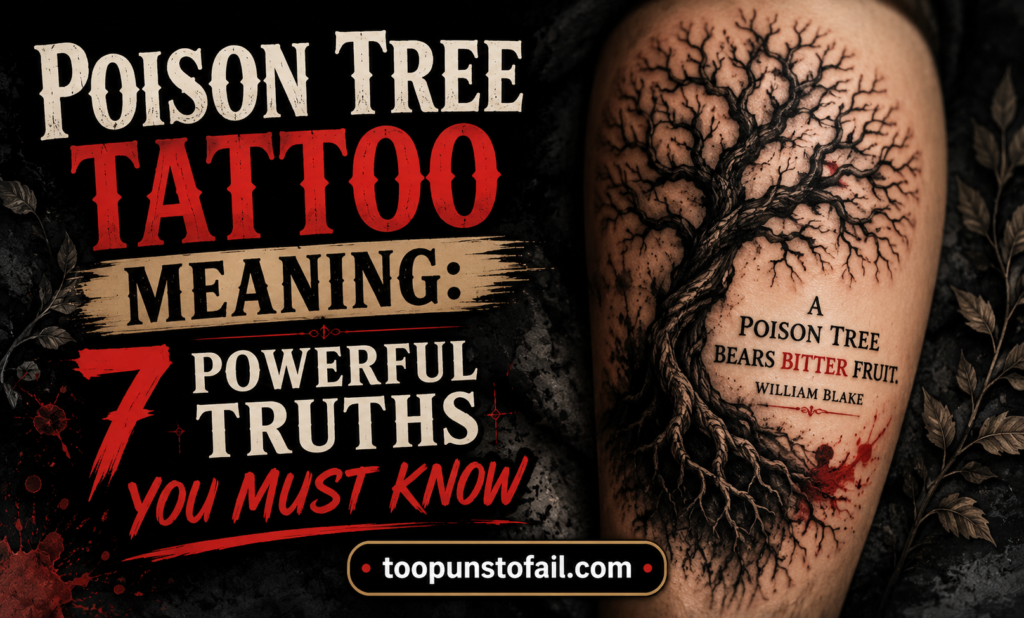
Poison Tree Tattoo Meaning is one of the most searched topics among people drawn to literary and symbolic body art. This single image, a tree bearing a poisoned apple, carries centuries of emotional weight packed into a few inches of ink. If you have ever wondered why so many people choose this design, Poison Tree Tattoo Meaning is exactly what you need to understand first.
Poison Tree Tattoo Meaning requires looking past the surface. It is not simply a tree. It is a story about buried anger, quiet resentment, and the strange fruit that grows when feelings are left to fester instead of being spoken aloud. That story has resonated with tattoo lovers for generations.
In this guide, we explore the origins of the design, its core symbolism, and the different ways men and women interpret Poison Tree Tattoo Meaning. By the end, you will have a complete picture of what this tattoo represents.
What Is a Poison Tree Tattoo?
A poison tree tattoo is a piece of body art that typically depicts a twisted or gnarled tree, often bearing a single glowing apple among its branches. Understanding this tattoo starts with recognizing that the tree is usually rendered with dark, tangled roots and thorny limbs.
The design is inspired directly by literature and psychology rather than nature itself. Unlike a simple oak tattoo, Poison Tree Tattoo Meaning carries an intentional narrative. The apple is rarely decorative. It represents the end result of something the wearer has nurtured internally.
Because the imagery is so rich, artists have huge creative freedom when working with this symbol. Some renditions look fairy tale like, with soft shading. Others lean gothic, with bare black branches and a blood red apple as the only splash of color.
The tree itself is often the most technically demanding part of the piece. Skilled artists spend considerable time on bark texture, knots, and root structure, since a flat or lifeless trunk can undercut the entire concept. A well executed trunk gives the whole piece a sense of age and history, as though the tree has been growing quietly for years before the apple ever appeared.
At its heart, this design is about what happens when emotion is left unspoken and allowed to grow into something toxic.
You May Also Like This : 15 Best Mexican Jokes That Will Have Everyone Laughing Loud
The Origins: William Blake’s “A Poison Tree” (1794)
To truly grasp Poison Tree Tattoo Meaning, you have to start with the source material. The design is directly inspired by William Blake’s 1794 poem “A Poison Tree,” published in Songs of Experience.
The poem opens with a contrast that shapes this symbolism to this day. Blake writes that when he was angry with a friend, he told his wrath and the anger ended. When he was angry with a foe, he stayed silent, and that unspoken anger grew.
Blake describes nurturing this hidden anger the way a gardener tends a plant, watering it with fears, warming it with false smiles. Over time, the anger bears fruit, a shining poisoned apple, which the foe eventually steals and eats, leading to their death.
This literary foundation is exactly why Poison Tree Tattoo Meaning feels so layered. People are not just tattooing a tree. They are tattooing a two hundred year old warning about suppressed emotion.
Many wearers choose to pair the tattoo with a line from the poem itself, deepening the personal weight of the tattoo’s meaning even further. Blake wrote several other poems in the same collection exploring similar emotional territory, but none captured the public imagination quite like this one, which is likely why it became such fertile ground for tattoo artists centuries later.
Poison Tree Tattoo Meaning: Core Symbolism
At its core, this symbol revolves around a handful of powerful themes that explain why the design has such staying power.
Suppressed anger. The most direct interpretation ties back to Blake’s poem. Poison Tree Tattoo Meaning represents anger that was never voiced, and the consequences of letting that anger simmer in silence.
Hidden danger beneath beauty. The tree often looks appealing, and the apple gleams invitingly. This duality speaks to how toxic situations can appear harmless on the surface.
Growth from pain. Just as a tree needs nourishment to grow, this tattoo suggests that even destructive feelings require energy to sustain.
Betrayal and consequence. Because the fruit ultimately kills the foe who steals it, the symbolism also reflects the idea that betrayal eventually catches up with people.
Transformation. For many, Poison Tree Tattoo Meaning marks a turning point, a moment when they chose to stop suppressing feelings and start confronting them.
Because it spans both warning and empowerment, this design shifts depending on who is wearing it and what chapter of life they are marking.
Who Gets a Poison Tree Tattoo and Why
People who choose this design fall into a few overlapping groups, each finding their own version of Poison Tree Tattoo Meaning.
Literature lovers are drawn to it because of its direct connection to Blake’s poem. For them, this symbolism is almost a badge of literary appreciation.
Survivors of toxic relationships often choose the design to mark the end of a painful chapter. The poisoned apple becomes a symbol of something that looked appealing at first but turned harmful over time.
People working through anger management sometimes choose Poison Tree Tattoo Meaning as a personal reminder to communicate honestly rather than let resentment build.
Gothic art enthusiasts are simply drawn to the aesthetic, appreciating the moody contrast between a twisted tree and a single glowing apple.
Finally, some select it purely for its ambiguity, since the design can look artistic without being obviously dark.
Poison Tree Tattoo Meaning For Girl
Poison Tree Tattoo Meaning for girl designs often leans into elegance alongside symbolism. Many women choose smaller renditions, with fine linework or minimalist outlines rather than heavy blackwork.
For a lot of women, the tattoo’s meaning represents resilience after emotional hurt. It can mark the end of a toxic friendship, a difficult breakup, or a period of self doubt. The apple becomes less about literal poison and more about lessons learned.
Some women pair the tree with feminine elements, such as small birds, blossoms, or a crescent moon tucked into the branches, softening the look while keeping Poison Tree Tattoo Meaning intact.
Placement choices for women frequently include the ribcage, forearm, or behind the ear for smaller versions. this symbol can be just as powerful in a two inch outline as in a full sleeve.
Ultimately, the appeal lies in reclaiming a difficult emotion and turning it into something beautiful and permanent.
Poison Tree Tattoo Meaning in Relationships
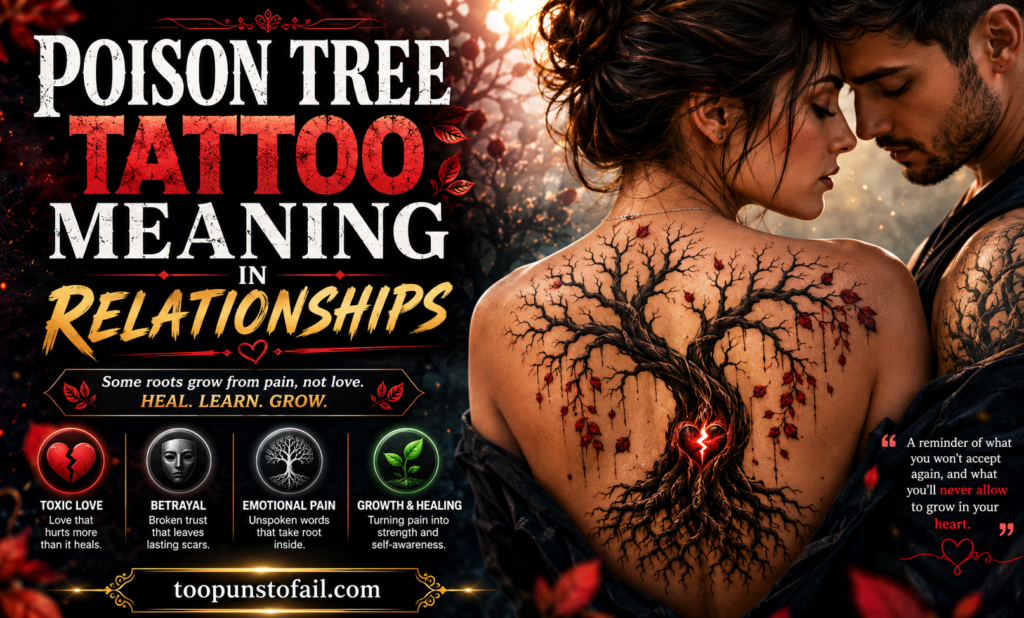
This tattoo in relationships becomes especially personal. Romantic and platonic relationships both provide fertile ground for this imagery.
In romantic contexts, the tattoo frequently represents a relationship that looked healthy but was quietly harmful underneath. The gleaming apple mirrors the initial charm of a partner who later revealed manipulative behavior.
Some people get the tattoo after ending a toxic relationship as a way of processing what happened. Poison Tree Tattoo Meaning becomes a marker of awareness, a reminder to recognize warning signs earlier.
Friendships carry the same weight. A close friend who behaved deceitfully can inspire someone to choose this design instead of a more obvious symbol of betrayal.
Family dynamics sometimes factor in too. A few wearers use this design to represent complicated relationships with parents or siblings, situations where resentment built up over years.
In every case, the relational meaning circles back to Blake’s original warning about unaddressed hurt.
Popular Design Variations
Because the symbolism is flexible, poison tree tattoo designs come in a wide range of styles, each expressing Poison Tree Tattoo Meaning differently.
Blackwork silhouette. A stark black tree against bare skin, often with a single red apple as the only color accent.
Realistic botanical. Highly detailed bark texture and a photorealistic apple, offering striking depth.
Minimalist line art. A simple outlined tree with one apple, favored by people who want subtle ink that still carries meaning.
Skeletal or dead tree. Bare, twisted branches with no leaves, emphasizing danger over natural beauty.
Fairy tale style. Often paired with a small snake coiled around the trunk, referencing broader folklore.
Watercolor. Soft washes of color bleeding around the outline, popular among wearers who want an artistic feel.
Text integrated. A tree combined with a handwritten line from Blake’s poem, curling around the trunk.
Choosing among these often comes down to preference, but each style still fully expresses this symbolism underneath.
Color Meanings in Poison Tree Tattoos
Color choice plays a real role in shaping Poison Tree Tattoo Meaning, since even small accents shift the emotional tone.
Black and grey. The most common palette, emphasizing shadow and mystery, keeping the focus on symbolism rather than decoration.
Red apple. The classic choice, referencing danger and temptation, reinforcing the idea of hidden danger at the heart of the tattoo’s meaning.
Green apple. Sometimes used to suggest envy or unripe emotion, implying the poison is still developing.
Purple or black apple. A less common choice, often representing a wound that has already caused lasting damage.
Gold apple. Suggests temptation dressed as reward, emphasizing how something harmful can appear valuable.
Full color trees. Softens the piece and shifts Poison Tree Tattoo Meaning toward growth rather than pure warning.
There is no single correct palette. Color simply lets wearers fine tune how dark or hopeful they want the piece to feel.
Poison Tree Tattoo Meaning For Guys
Poison Tree Tattoo Meaning for guys tends to favor bolder, larger scale designs compared to feminine interpretations, though there is overlap.
Many men choose the tattoo to represent internalized anger or emotional suppression, particularly during times when vulnerability felt difficult. this symbol becomes a way of externalizing something once kept hidden.
Larger placements are common among men, including forearm pieces and back pieces that allow for detailed branch work and shading, giving room for the full weight of Poison Tree Tattoo Meaning to show.
For some men, the tattoo marks recovery from betrayal, whether in business, friendship, or romance. The poisoned apple becomes a symbol of a person who seemed trustworthy before revealing their true nature.
Others are drawn purely to the strength of the imagery, appreciating how the tree conveys resilience even without a deep personal backstory.
Best Placement Options for a Poison Tree Tattoo

Placement significantly affects both the visual impact and privacy of the design, so it is worth considering carefully.
Forearm. Popular for medium to large designs, offering space for detailed branches while remaining easy to cover.
Ribcage. Favored for private placements, since the area is easily hidden but allows a tall, narrow tree shape.
Back. Ideal for large, detailed pieces, especially designs with roots stretching across the lower back.
Thigh. Offers a large flat canvas well suited to intricate shading, remaining easily concealed.
Behind the ear or wrist. Best for minimalist versions, where a small tree silhouette communicates the symbolism without demanding much space.
Calf or shin. A less common but increasingly popular choice, offering a long vertical canvas.
When choosing placement, consider how often you want the tattoo visible and how the design will age with the natural curves of that body area. It also helps to think ahead to future life stages, since a piece placed somewhere highly visible today may need to be covered for certain jobs, formal events, or family gatherings later on. Choosing a spot that can be concealed with clothing when necessary gives you more flexibility without sacrificing the size or detail you actually want.
Healing time varies by placement as well. Areas with thinner skin, like the ribcage or behind the ear, tend to be more sensitive during the tattooing process itself, while fleshier areas such as the thigh or upper back are generally easier to sit through for longer sessions.
Psychological Dimension: Why This Symbol Resonates So Deeply
The enduring appeal of this tattoo is not accidental. It taps into something deeply human, the universal experience of holding onto unspoken feelings.
Psychologists have long noted that suppressed emotion does not simply disappear. Left unaddressed, it tends to resurface as anxiety, resentment, or strained relationships. Blake’s poem captured this dynamic long before modern psychology gave it formal language.
Modern therapy often encourages naming difficult feelings early rather than letting them accumulate silently. The tattoo essentially visualizes the opposite path, showing what happens when that early naming never takes place. For some wearers, simply seeing the ink in the mirror each day becomes a quiet nudge to speak up rather than let something small turn into something much larger.
Choosing a permanent piece of art based on this idea often reflects genuine self awareness. Wearers are not glorifying toxicity. Instead, many use Poison Tree Tattoo Meaning as a personal contract, a reminder to communicate honestly.
There is also a cathartic element. Getting tattooed is itself a ritual for many, a way of marking closure after a painful experience. Choosing imagery tied to buried anger allows wearers to externalize something they can now release rather than carry silently.
Finally, the duality of beauty paired with danger mirrors how complicated real emotional experiences actually are, which is exactly why this design resonates so widely.
Poison Tree Tattoo Meaning in Different Cultures
While the specific design traces back to an English poem, the broader symbolism connects to themes found across many cultures, adding depth to this symbolism worldwide.
In Western folklore, poisoned fruit appears repeatedly, from the Garden of Eden story to the poisoned apple in Snow White. Both narratives link a tempting fruit to hidden danger, reinforcing the same warning Blake explores.
In various Eastern traditions, trees often symbolize the balance between growth and decay occurring within the same living structure. A twisted tree can represent imbalance, a natural order disrupted by hidden corruption.
Celtic symbolism treats trees as guardians of memory, with certain species associated with protection and others with warning. A blackened or thorned tree fits naturally into this darker branch of tree symbolism.
Slavic folklore includes stories of cursed orchards and enchanted fruit that bring misfortune, echoing the same cautionary structure found in Blake’s work.
Because so many cultures independently developed stories about dangerous fruit, Poison Tree Tattoo Meaning feels instinctively familiar regardless of background. This cross cultural pattern also explains why the design travels well internationally, resonating with people who may never have read Blake’s poem but instantly recognize the warning embedded in a poisoned piece of fruit hanging from an otherwise ordinary tree.
How to Choose the Right Poison Tree Tattoo Design
Selecting the right version comes down to matching visual style with your personal reason for embracing Poison Tree Tattoo Meaning.
Start by clarifying your motivation. If the tattoo marks a specific relationship or experience, consider incorporating a personal detail, such as a date hidden in the roots.
Think about scale honestly. A ribcage or back piece allows intricate detail, while a wrist placement demands a simplified approach. Choose a size that matches your desired level of visibility.
Consider color carefully. A stark black and grey piece reads as more serious in tone, while a red apple accent adds warmth and draws attention to the central symbol.
Research your artist’s portfolio before booking. Botanical specialists tend to render bark texture with far more nuance than generalists, which matters for a design this detail dependent. Look specifically for previous tree or nature focused pieces in their portfolio rather than judging based on unrelated work, since tree structure and bark rendering is its own specialized skill within tattooing.
Budget and session length are also worth planning for in advance. Larger, more detailed versions of this design often require multiple sittings to complete properly, and rushing a piece this symbolic rarely produces the best result.
Finally, decide whether you want the literary connection made explicit, or whether you prefer to let Poison Tree Tattoo Meaning stay private between you and the ink.
Frequently Asked Questions
What does a poison tree tattoo mean?
Poison Tree Tattoo Meaning generally centers on suppressed anger, hidden danger beneath an appealing surface, or the consequences of unresolved emotional conflict, inspired by William Blake’s poem “A Poison Tree.”
Where does the poison tree tattoo symbolism come from?
Poison Tree Tattoo Meaning originates from William Blake’s 1794 poem “A Poison Tree,” published in Songs of Experience, describing how hidden anger nurtured in silence eventually produces a poisoned apple.
Is a poison tree tattoo a bad omen?
Not necessarily. While the imagery references anger and danger, most wearers choose Poison Tree Tattoo Meaning as a symbol of self awareness and closure rather than as a genuine bad omen.
What does the apple mean in a poison tree tattoo?
Within Poison Tree Tattoo Meaning, the apple represents the end result of nurtured negative emotion, looking appealing on the surface but carrying hidden danger underneath.
What is a good placement for a poison tree tattoo?
Popular placements include the forearm, ribcage, back, and thigh for larger designs, while the wrist or behind the ear works well for smaller versions of Poison Tree Tattoo Meaning.
Do poison tree tattoos always have a dark meaning?
No. While rooted in a poem about suppressed anger, many wearers reinterpret Poison Tree Tattoo Meaning as a symbol of resilience, closure, or personal transformation.
Conclusion
Poison Tree Tattoo Meaning is far richer than a single glance might suggest. Rooted in William Blake’s timeless poem, this design captures something universally human, the danger of letting unspoken anger quietly take root.
Whether chosen by someone processing a toxic relationship, a literature lover honoring a favorite poem, or someone drawn to its visual contrast, Poison Tree Tattoo Meaning carries genuine depth beneath its striking surface.
From color choices to placement, from feminine minimalist versions to bold masculine forearm pieces, the design remains endlessly adaptable while staying true to its core message. If this symbolism speaks to your own story, embracing Poison Tree Tattoo Meaning offers a powerful, permanent way to mark it.

I’m Andy Borowitz, an American writer, comedian, and satirist known for political humor and sharp social commentary. I helped create The Fresh Prince of Bel-Air and founded The Borowitz Report, a popular satirical news column. My work has also appeared in The New Yorker, earning recognition for its witty take on politics and current events.

1 thought on “Poison Tree Tattoo Meaning: 7 Powerful Truths You Must Know”